 Hearmony
Types of Chords and How to Identify Each One by Ear
The main types of chords are four triads (major, minor, diminished and augmented), two suspended chords (sus2 and sus4) and three common seventh chords (dominant 7th, major 7th and minor 7th). Each type has its own sound: major is bright, minor is darker, diminished is tense, augmented is dreamy and unresolved, sus chords float, and seventh chords add color on top. To identify a chord by ear, compare it to a plain major chord and ask what changed.
What are the types of chords?
A chord is three or more notes sounding together, and most chords in Western music are built by stacking thirds on a root note. The table shows the nine types you will meet most often, all spelled on C so you can play them and compare.
| Chord type | Symbol | Notes on C | Built from | Listening cue |
|---|---|---|---|---|
| Major | C | C–E–G | Major 3rd + minor 3rd | Bright, stable, finished |
| Minor | Cm | C–E♭–G | Minor 3rd + major 3rd | Darker, softer, still stable |
| Diminished | Cdim | C–E♭–G♭ | Two minor 3rds | Tense, cramped, wants to move |
| Augmented | Caug | C–E–G♯ | Two major 3rds | Dreamy, stretched, unresolved |
| Suspended 2nd | Csus2 | C–D–G | 2nd + 5th, no 3rd | Open and airy, neither happy nor sad |
| Suspended 4th | Csus4 | C–F–G | 4th + 5th, no 3rd | Hanging; the F wants to fall to E |
| Dominant 7th | C7 | C–E–G–B♭ | Major triad + minor 7th | Bluesy, restless, pulls toward F |
| Major 7th | Cmaj7 | C–E–G–B | Major triad + major 7th | Smooth, soft, a little jazzy |
| Minor 7th | Cm7 | C–E♭–G–B♭ | Minor triad + minor 7th | Mellow, relaxed, soulful |
Beyond these you will find half-diminished and diminished seventh chords, sixth chords, add9 chords and extended chords (9ths, 11ths, 13ths). They are all built on the same idea, so the nine above are the foundation.
What is chord quality?
Chord quality is the type of a chord, set by the intervals above its root: major, minor, diminished, augmented and so on. C major and G major share the same quality on different roots; C major and C minor share a root but differ in quality.
Quality is what you are listening for when you identify chords by ear. The root tells you which chord it is in the key, and the inversion tells you which note is at the bottom, but quality is the color. A C major chord played as E–G–C (first inversion) still sounds major. For the deepest look at the most important pair, see our page on major vs minor chords.
How do you identify chords by ear?
You identify a chord by comparing it to a reference you already know, usually a plain major chord, and asking a few yes-or-no questions in order.
- Is there a third? If the chord sounds hollow, neither happy nor sad, it is probably a sus chord. A sus4 often resolves to major right after, which gives it away.
- Bright or dark? Major-family chords (major, augmented, dominant 7th, major 7th) sound bright at the core; minor-family chords (minor, diminished, minor 7th) sound darker.
- Is the top stable? A normal fifth sounds settled. If the chord feels squeezed, the fifth is lowered (diminished). If it feels stretched and floating, the fifth is raised (augmented).
- Is there a fourth note? A seventh chord sounds thicker. A dominant 7th has a bluesy pull; a major 7th has a gentle rub between the 7th and the root an octave above; a minor 7th sounds like a relaxed minor chord.
Play the chord as an arpeggio (one note at a time, low to high) and then together. Hearing the notes spread out makes the third and fifth easier to catch; hearing them together trains the color you need in real music.
What are the most common chords?
Major and minor chords are by far the most common, because a major key's own chords are mostly those two qualities. In C major, the chords built on each scale degree are:
- Major: I, IV and V (C, F, G)
- Minor: ii, iii and vi (Dm, Em, Am)
- Diminished: vii° (B diminished)
The dominant 7th is the next most common, because adding a seventh to V (G7 in C major) makes the pull back to I even stronger. Sus chords are frequent in pop and rock as a color on top of major chords, while augmented chords are comparatively rare in everyday pop songs. Hearing how these chords move together is the next skill, covered in how to hear chord progressions by ear.
In what order should you learn chord types?
Learn chord types in pairs that differ by one note, starting with the biggest difference. This order works well:
- Major vs minor (the third moves by a half step).
- Add diminished (minor with a lowered fifth) and compare it with minor.
- Add augmented (major with a raised fifth) and compare it with major.
- Add sus2 and sus4, compared with major.
- Add dominant 7th, then major 7th and minor 7th.
- Mix all nine, then try them in inversions.
These are the pairs people confuse most, with a cue for each:
| Often confused | Notes on C | How to tell them apart |
|---|---|---|
| Major vs sus4 | C–E–G vs C–F–G | Sus4 sounds unfinished and usually resolves to the major chord. |
| Major vs augmented | C–E–G vs C–E–G♯ | Augmented keeps the brightness but loses the stability; it sounds like it is floating upward. |
| Minor vs diminished | C–E♭–G vs C–E♭–G♭ | Diminished is darker and tighter, with a tritone between C and G♭. |
| Dominant 7th vs major 7th | B♭ vs B on top | Dominant 7th wants to move; major 7th is content to stay. |
| Minor vs minor 7th | C–E♭–G vs C–E♭–G–B♭ | Minor 7th sounds softer and fuller, less sad. |
Seventh chords get a full page of their own: dominant 7th, major 7th and minor 7th chords. So do sus2 and sus4 chords and the diminished chord.
A 10-minute daily chord drill
Ten minutes a day with a keyboard or guitar is enough to make chord colors familiar. Keep the same structure every day and widen the pool as you go.
- 2 minutes: play each chord in your current pool on C, slowly, naming it out loud.
- 3 minutes: play the same chords on a different root (F, G or A) so you learn the color, not the pitch.
- 5 minutes, self-test: have a friend or an app play random chords from the pool; name each one before checking. Note which pairs you miss and spend tomorrow's first minutes on them.
Practice chord types in Hearmony
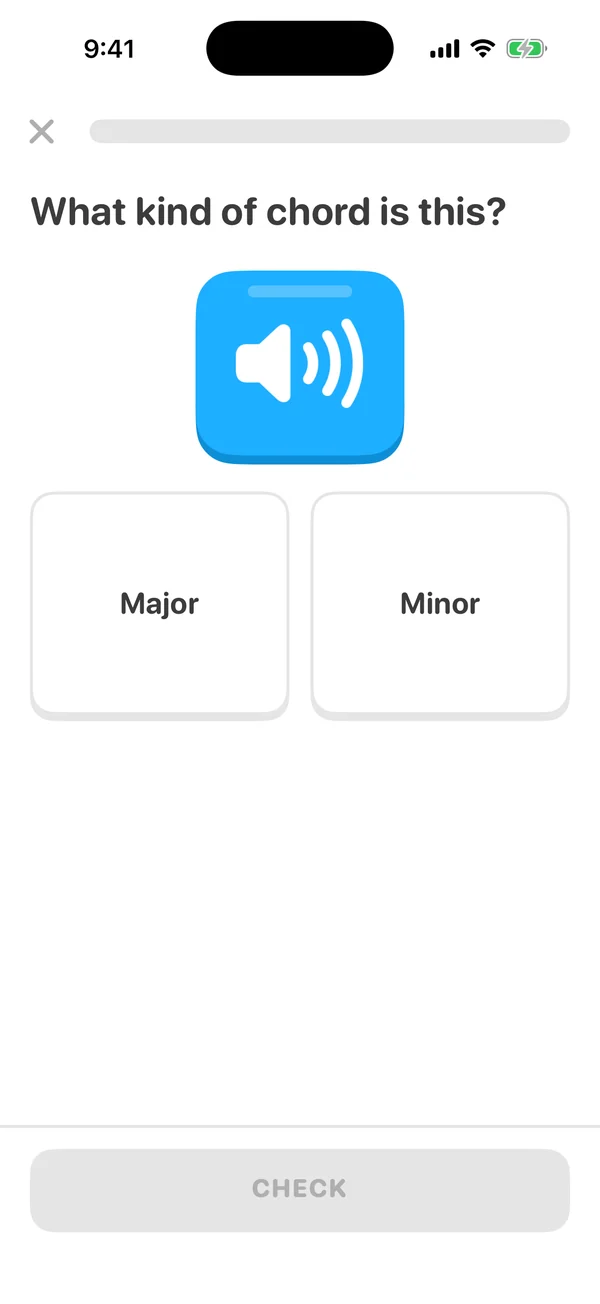
Hearmony's Chord Garden adventure follows the order above: major and minor first, then diminished, augmented, and sus2 and sus4, each introduced next to the chord it is most easily confused with. Seventh Heaven adds dominant 7th, major 7th and minor 7th, then inversions, then all nine types mixed. Besides "What kind of chord is this?", there are odd-one-out questions where you tap three chords and pick the one that sounds different. Lessons are 10 questions long, and every answer shows the notes of the chord you heard. Get Hearmony for iPhone on the App Store; the beginner ear training plan shows where chord work fits among the other skills.
For the written theory of how triads are built from stacked thirds and labeled, see the reference entry on triads.