 Hearmony
Ear Training for Beginners: Exercises and a 7-Day Plan
Ear training means learning to name what you hear in music: which note is higher, how far apart two notes are, whether a chord is major or minor, where "home" is in a song. The best ear training exercises for beginners start with big, obvious differences and shrink them step by step. Ten focused minutes a day beats an hour on Sunday, and the 7-day plan below shows exactly what to practice.
What is ear training?
Ear training is the practice of connecting sounds to musical names, so that you hear C up to G and know it's a perfect fifth, or hear a chord and know it's minor. Music schools call it aural skills, and it's a standard part of every theory course.
Most of ear training builds relative pitch: hearing notes in relation to each other. That is different from perfect pitch, the rare ability to name a single note with no reference. Relative pitch is what lets musicians play by ear, transcribe songs and tune up with a band, and it responds well to regular practice.
How do I start ear training? Learn the skills in this order
Start with pitch direction, then intervals, then chords, then how notes and chords behave inside a key. Each skill leans on the one before it, so the order matters more than the app or book you use.
| Step | Skill | What you're listening for | First exercise |
|---|---|---|---|
| 1 | Pitch direction | Is the second note higher, lower or the same? | C then E, C then A below it, C then C |
| 2 | Intervals | The distance between two notes | Major third (C–E) vs perfect fifth (C–G) |
| 3 | Chord quality | The color of a chord: major, minor and beyond | C major (C E G) vs C minor (C E♭ G) |
| 4 | Scale degrees | Where each note sits in the key, and where "home" is | Hum the last note of a phrase: is it do? |
| 5 | Chord progressions | How chords move: I, IV, V, vi | C–F–G–C: hear the return home |
| 6 | Rhythm | Pulse, meter and tempo | Count 1-2-3 (waltz) vs 1-2-3-4 (march) |
| 7 | Fine pitch | Tiny tuning differences | Two Cs, one slightly sharp |
Rhythm can run alongside everything else; it doesn't depend on pitch skills. Fine pitch is the last step because it only matters once you hear the big picture.
If you're worried that you can't hear pitch at all, read how to tell if you're tone deaf first. Most people who think they're tone deaf simply haven't practiced listening yet.
The best ear training exercises for beginners
These six exercises cover the first steps of the skill map. Use a piano, a keyboard app or a guitar, and have a friend play or use random playback so you can't see the answer.
- Higher or lower. Play C, then a second note. Say "higher", "lower" or "same" before you look. Start with wide gaps (C–A) and work down to a half step (C–C♯).
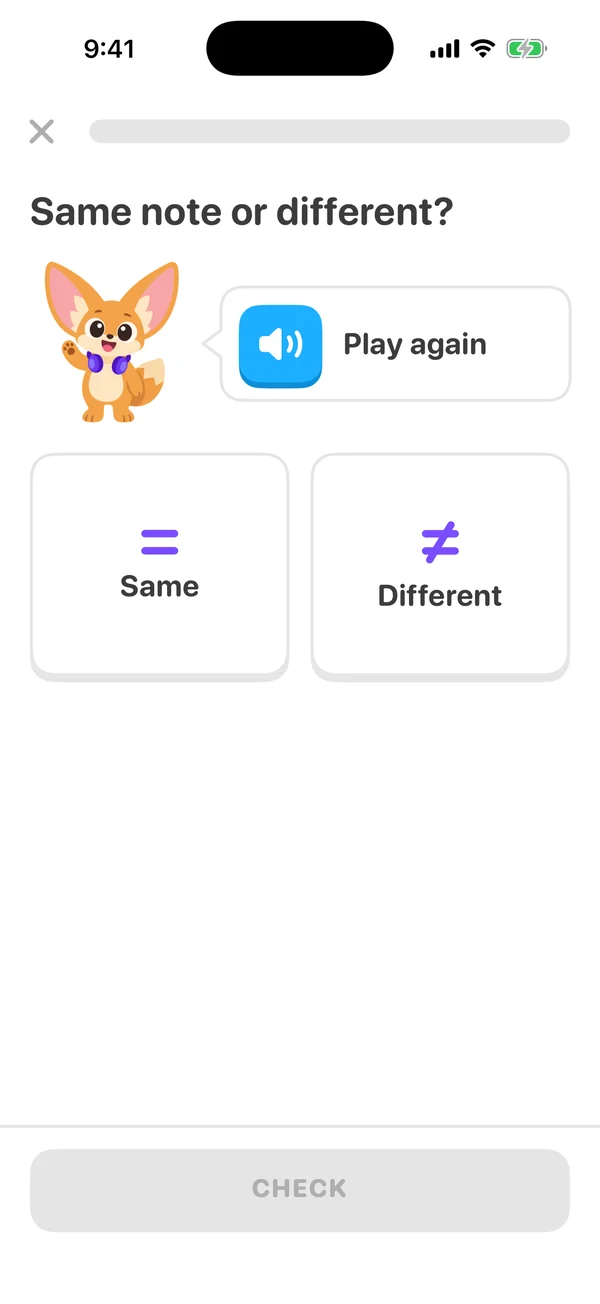
- Same or different. Play two notes that are sometimes identical. This sounds trivial until the gap is a half step; then it trains real focus.
- Two-interval contrast. Compare only the major third (C–E) and the perfect fifth (C–G). The opening of "When the Saints Go Marching In" is a major third; the jump in "Twinkle, Twinkle, Little Star" is a fifth. Our interval songs chart has a reference for every interval.
- Major or minor. Play C E G, then C E♭ G. Only the middle note changes, by one half step. The major vs minor chords guide has a 10-pair listening drill.
- Find home. Play or listen to a short tune, stop, and hum the note that would end it. That resting note is the tonic, or do. This is the root of scale degrees and of finding the key of a song.
- Tap the meter. Put on any song, tap the beat and count. If "1-2-3" fits, it's in three, like a waltz; if "1-2-3-4" fits, it's in four, like most pop songs.
Answer out loud before you check. Saying "minor" commits you to a guess, and committed guesses teach your ear much faster than "I think I knew that".
A 7-day ear training plan (10 minutes a day)
This plan gives you one week of daily ear training, about 10 minutes a day, with a mixed review at the end. Aim for 10 questions per exercise and write down how many you got right on the first try.
| Day | Focus | What to do |
|---|---|---|
| 1 | Pitch direction | Higher/lower and same/different, 5 minutes each. Shrink the gaps as you go. |
| 2 | Two intervals | Major third (C–E) vs perfect fifth (C–G), going up. Sing the song reference in your head first. |
| 3 | Four intervals | Add the perfect fourth (C–F, "Here Comes the Bride") and the octave (C–C, "Over the Rainbow"). Mix all four. |
| 4 | Chord quality | Major vs minor triads on different roots: C, F, G, A. |
| 5 | Home note | Play C E G, then single notes from the C major scale. Name each one by its distance from C, or as do, mi, sol. |
| 6 | Rhythm | Three songs in three, three in four. Tap and count each. |
| 7 | Mixed review | 10 random questions from days 1–5. Note your score; next week, add two new intervals. |
In week two, add descending intervals (C down to A, C down to G), and in week three start on hearing chord progressions, beginning with the four-chord pop progression.
How much ear training per day, and how long does it take?
Ten to fifteen minutes a day is enough for a beginner. Short daily sessions work better than long weekly ones because your ear consolidates between sessions, and attention drops quickly once the same sounds start to blur together.
How long it takes depends on the skill. Pitch direction and major vs minor often settle within a few weeks of daily practice; a full set of intervals going up and down takes longer; chord progressions and seventh chords are months-long projects. Treat each skill as done when you score 8 out of 10 on the first try on two different days, then keep it in a mixed review.
Does ear training work? How to tell you're improving
Yes, relative pitch skills improve with practice, and you can measure it yourself. Keep a simple log: date, exercise, first-try score out of 10. Scores that climb from 5 to 8 over two weeks are progress you can see, not just a feeling.
Real-world signs follow the scores. You notice the bass moving under a song, you recognize a minor chord in a film score, or you can pick out the first notes of a melody on your instrument without trial and error.
Common mistakes and how to fix them
- Practicing only ascending intervals. Melodies go down as often as up. Add descending versions from week two.
- Always the same starting note. If every interval starts on C, you may be memorizing the second note instead of the distance. Change the starting note every few questions.
- Too many new items at once. Learning all twelve intervals in one go creates a blur. Two new items at a time, then mix.
- Only one sound. Practice with both piano and guitar tones if you can; real music comes in many timbres.
- Skipping review. Old skills fade if you never meet them again. End each week with a mixed set.
Ear training for guitar, piano and singers
The skills are the same for every instrument, but the payoff shows up differently.
- Guitar: intervals map to fret distances (a perfect fifth is 7 frets on one string), and chord quality helps you work out songs by ear. Sus chords and diminished chords come up often.
- Piano and keys: connect what you hear to what you read. Pair ear training with treble and bass clef notes so the sound, the key and the written note line up.
- Singers: hearing intervals and the home note keeps you in tune. Practice listening first, then check by humming.
- Listeners: ear training changes how you hear recordings. Chord types and progressions are the most rewarding place to start.
Curious about the other end of the spectrum? See how to know if you have perfect pitch and whether perfect pitch can be learned.
Go deeper: the theory behind what you hear
Ear training and music theory feed each other: a name for a sound makes it easier to hear again. These guides take each topic from the plan one step further.
Start here
- Music Theory Basics: What to Learn and in What Order
- How to Read Sheet Music, Step by Step, From Staff to Repeat Signs
Notes, steps and intervals
- What Is a Semitone? Half Steps and Whole Steps Explained
- What Is an Octave? Definition, Notes and How It Sounds
- The Chromatic Scale: All 12 Notes, Spelled and Heard
Scales, keys and modes
- The Major Scale: Formula, All 12 Keys and How It Sounds
- Minor Scales: Natural, Harmonic and Melodic Minor Side by Side
- Relative Minor: How to Find It in Any Key (With Chart)
- The Pentatonic Scale: Major and Minor, Explained
- The Blues Scale: Notes, Formula and Why Blue Notes Sound Blue
- Music Modes Explained: The 7 Modes and How Each One Sounds
- Key Signatures: Chart, Order of Sharps and Flats, and How to Read Them
- The Circle of Fifths: How to Read It and Use It
- How to Transpose Music: Two Methods, a Chord Chart and Worked Examples
Chords and harmony
- What Is Harmony in Music? Meaning, Examples and How to Hear It
- What Is a Triad? Major, Minor, Diminished and Augmented Triads
- Augmented Chord: What It Is, How to Build It and How It Sounds
- Chord Inversions: How They Work and How They Sound
- What Is an Arpeggio? Meaning, Patterns and How It Trains Your Ear
Progressions and cadences
- 10 Common Chord Progressions, With Numerals, Chords in C and Songs
- Cadence in Music: The 4 Types of Cadences and How to Hear Them
- The ii–V–I Progression: How It Works in Major and Minor
- The 12 Bar Blues: The Chord Progression Bar by Bar
- The Nashville Number System Explained, With a Worked Chart
Rhythm
- Music Note Values: How Many Beats Each Note and Rest Gets
- Time Signatures Explained: How to Read and Count 4/4, 3/4, 6/8 and More
- What Is Syncopation? Examples and Clap-Along Exercises
Singing, reading and playing by ear
- Solfege Explained: Do Re Mi, Hand Signs and Movable Do
- Sight Singing: A Step-by-Step Method and Practice Exercises
- How to Sing in Tune: Pitch-Matching Steps for Beginners
- Melodic Dictation: A Step-by-Step Routine, With Tips and Practice
- How to Play Piano by Ear: Find the Melody, Then the Chords
Practice this plan in Hearmony
Hearmony, the iPhone ear-training app the Hearmony team builds, follows the same order as the skill map. Its path of 12 adventures starts with First Notes (higher/lower, same/different), moves through Leap Lagoon and Interval Peaks for intervals, Chord Garden for chord quality, Home Key Harbor for scale degrees in solfège, Progression Highway for I–IV–V and ii–V–I, and Rhythm Ranch for meter and tempo. Tuning Lab trains fine pitch down to about 6 cents.
Each lesson is 10 questions with a sampled grand piano or clean electric guitar sound, and the Daily Ear Workout mixes everything you've learned for the weekly review step. The first adventure and the Note Reading side quest are free. If you'd rather compare options first, see our ear training app comparison.